Storm Damage Roof Repair in Belleair Bluffs, FL:
Wind Off the Water, 1970s Roofs.
Storm damage roof repair in Belleair Bluffs usually means wind straight off the Intracoastal hitting a roof on a home built before 1980. When that roof starts leaking, we stop the water first, then go over every slope, the flashing and the attic, and leave you a dated photo report that is yours to use. Repairs and new roofs we install carry a 15-year workmanship warranty in writing, stacked on the manufacturer's coverage, and we pull the SAFEbuilt permit in our name.
Takes about 30 seconds. A local roofing specialist follows up the same business day.
Helene and Milton on the Record Near Belleair Bluffs
Start with what can be shown. On September 27, 2024, a WUSF photographer captured flooding and damage along Belleair Causeway after Hurricane Helene. The east end of the causeway, at the boat ramp on West Bay Drive, lies inside Belleair Bluffs. The closest tide gauge, at Clearwater Beach, measured water 6.67 feet above the normal high tide mark, the highest at that station since its records began in 1973 and higher than the Superstorm of March 1993. The same station logged a Helene gust near 74 mph.
Two weeks later, Milton came ashore far to the south near Siesta Key. The Clearwater Beach station still recorded a gust of about 90 mph, and the National Hurricane Center described hurricane conditions along the coast from Clearwater Beach and Tampa southward. That station sits roughly 4 miles north of the city, so read these as nearby measurements, not readings taken in Belleair Bluffs.
What nobody has published is a local damage count. We found no tally of damaged roofs, homes or storm permits for the city after either hurricane. The city’s hurricane page says only that the two storms are “stark reminders” of what a hurricane can do. If someone gives you a number for your street, ask where it came from.
Storms Logged Near Belleair Bluffs
- Hurricane Helene, Sept. 2024
- Flooding and damage photographed along Belleair Causeway on Sept. 27; 6.67 ft above high tide and a 74 mph gust at the Clearwater Beach gauge
- Hurricane Milton, Oct. 2024
- 90 mph gust at the Clearwater Beach station; landfall far to the south near Siesta Key
- July 13, 2021
- 42 mph thunderstorm gust at a weather station in Belleair, logged at Belleair Bluffs
- 2019 and 2022
- Dime-size hail reported in Belleair Bluffs more than once
- City damage counts
- None published for Helene or Milton
Ten Years of Wind Over the City
Big storms are only part of the picture. A weather station in Belleair logged a 42 mph thunderstorm gust in July 2021, the kind of summer cell that never gets a name. Model data for the city puts annual rain at about 54 inches, enough that a small opening in a roof gets tested again and again.
The chart shows a decade of modeled peak gusts. Those are estimates from a weather model, not measurements, but they show the pattern: most years bring a few sharp wind days, and 2024 brought two in quick succession. A roof that came through Helene with a loosened edge had only two weeks before Milton tested the same spot.
See the numbers
| Month | Avg high | Avg rain | Strongest gust |
|---|---|---|---|
| Jan | 67°F | 3 in. | 61 mph (Jan 17, 2016) |
| Feb | 72.2°F | 2.1 in. | 55 mph (Feb 6, 2020) |
| Mar | 75.2°F | 1.8 in. | 49 mph (Mar 22, 2024) |
| Apr | 79.6°F | 2.8 in. | 50 mph (Apr 30, 2023) |
| May | 84.1°F | 4 in. | 48 mph (May 24, 2017) |
| Jun | 86°F | 7.1 in. | 47 mph (Jun 6, 2016) |
| Jul | 87.3°F | 8.3 in. | 50 mph (Jul 6, 2021) |
| Aug | 87.3°F | 9.5 in. | 63 mph (Aug 4, 2024) |
| Sep | 85.9°F | 7.5 in. | 85 mph (Helene) |
| Oct | 82.5°F | 3.3 in. | 98 mph (Milton) |
| Nov | 76.1°F | 1.9 in. | 62 mph (Nov 11, 2020) |
| Dec | 71.3°F | 3.2 in. | 52 mph (Dec 21, 2018) |
Source: Open-Meteo historical weather (ERA5 reanalysis), daily data for Belleair Bluffs 2016–2025.
Why a 1970s Roof Lets Go in a Gust
Belleair Bluffs grew up fast. By 2020 to 2024 Census estimates, the median home dates to 1972, about 4 in 10 homes went up during the 1970s alone, and roughly 8 in 10 predate 1980. Almost nothing has been built since 2000. The shingles on a house that age have likely been replaced more than once, but the deck boards, their nails and the ties between roof and walls are often the ones the builder put in.
Wind doesn’t push a roof down. It flows over the top and pulls upward, and that pull is strongest at the edges. On an older roof, a hard gust usually goes after the same few spots:
- Sealant strips. Years of sun turn the glue under each shingle brittle, and one gust can break the bond.
- Creased tabs. A shingle that flaps folds across its width. Even lying flat again, the crease is weak.
- The starter course. Wind slips under a bent drip edge and strips a row of shingles from the eave or rake.
- Ridge caps. They sit highest, in the fastest air, and tend to be the first pieces found in the yard.
- Flashing and boots. Every gust flexes the metal around pipes and walls, and old sealant there splits.
Most of this can’t be seen from the driveway. A full roof inspection covers every slope, all the flashing and the underside of the deck from the attic.
Rain That Comes In Sideways
Hurricane rain rarely falls straight. It drives across the roof at an angle, and much of the city sits on a bluff about 40 feet above the Intracoastal, open to wind coming off the water. Water gets pushed up under shingles that wind has already lifted, behind loose flashing and into the gap at a cracked pipe boot.
Once it is under the surface, water runs down the underlayment or the bare deck until it finds a seam. That can be several feet from where it got in, which is why a ceiling stain often sits nowhere near the real opening. Wet wood and soaked insulation then hold moisture against the deck for days. Leave a small opening through one rainy season and a short repair can become new decking. Our roof leak repair page explains how we trace water back to its entry point.
Dime-Size Hail Has Been Reported Here
Hail turns up in the weather service record for Belleair Bluffs more than once, at dime size. Stones that small seldom punch through anything. What they do is knock off the granules that shield asphalt shingles from the sun. The bare spots then bake and wear out years ahead of the rest of the roof, and on shingles that were already shedding grit, one hail cell can use up most of the life left.
Check the bottom of each downspout for a fresh pile of granules, look for round dark marks on the shingles, and run a hand along metal vents and gutters for dents. Granule loss rarely leaks the next day, so hail damage tends to get found a season later, when it is harder to tie to a date.
What Small Hail Leaves Behind
- Grit at the downspoutA fresh spill of granules after the storm passes
- Bare spotsRound dark marks where the granule coat came off
- Dings in metalVents, gutters and drip edge show strikes clearly
- Split pipe collarsAged rubber boots crack when hit
Condo Buildings and Houses Are Not the Same Call
Belleair Bluffs has more condos and apartments than houses. The city counts 540 single-family homes, 650 condo units and 320 apartments, and the Census puts about 44% of homes in buildings with 20 or more units. That changes who acts after a storm.
If you own a house, the roof decision is yours. If you own a condo, the building’s roof is the association’s, and the board or manager decides who repairs it. Report a leak to them right away, with dated photos. Tenants should go to the building owner. For larger buildings, the commercial roofing and flat roofing pages cover low-slope systems, and residential roofing covers the houses.
Who Calls a Roofer After a Storm
- Single-family house
- The homeowner decides on the repair or the new roof
- Condo unit
- The association decides on the building's roof
- Apartment
- The building owner decides; tenants report leaks to them
- The city's own count
- 540 single-family homes, 650 condo units and 320 apartments
Before Anyone Climbs a Ladder
A few steps help in the hours after the wind drops. Stay off the roof. Take dated photos of shingles on the ground, bent gutters and any fresh spot on a ceiling. Put out buckets and towels, and move rugs and electronics clear of drips. Write down when the water first showed. Whether to call your insurance company is your decision.
The city’s own advice for hurricane season is to “check your insurance, secure outdoor items, and reinforce windows and doors” before a storm. After one, send us the address. If water is still coming in, stopping that active leak is the first job when we get there. Your roof will already be measured from high-resolution satellite imagery, so the visit is spent looking for damage instead of pulling a tape.
Right After the Storm Passes
- Keep off the roofWet surfaces are slick and a soaked deck can be soft
- Photograph and date itShingles in the yard, bent gutters, new ceiling stains
- Protect the roomBuckets, towels, and electronics moved out of the drip
- Write down the hourNote when water first appeared inside
- The claim is yoursCalling your insurer or not is your decision
Is Your 33770 Address Inside the City?
A Belleair Bluffs mailing address doesn’t prove a home is in the city. Some 33770 addresses sit in the City of Largo, and some sit in unincorporated Harbor Bluffs, south of West Bay Drive. The difference decides who issues the permit and which flood rule applies.
Look the property up on pcpao.gov and find the tax district on its record. BBL is the City of Belleair Bluffs. BTF is unincorporated land, permitted by Pinellas County under the county’s 49% flood rule, even though its name says Belleair Bluffs. Watch for look-alike codes: BB is Belleair Beach, BL is the Town of Belleair and BS is Belleair Shore. If your home turns out to be in Harbor Bluffs, our Harbor Bluffs page and roof replacement in Harbor Bluffs explain the county side.
Check the Tax District on Pcpao.Gov
- BBL
- City of Belleair Bluffs; SAFEbuilt permit and the city's 50% flood rule
- BTF
- Unincorporated, not the city; Pinellas County permit and the county's 49% rule
- Codes that look alike
- BB is Belleair Beach, BL is Belleair, BS is Belleair Shore
- Largo addresses
- Some homes with this mailing address are in the City of Largo
Storm Damage Roof Repair in Belleair Bluffs: SAFEbuilt Permits
Inside the city line, permits no longer go through Pinellas County. Since August 2025, SAFEbuilt has run permitting and inspections for Belleair Bluffs, with applications sent by email to [email protected] and tracked in an online portal. Zoning review happens alongside the building review, so a re-roof doesn’t wait on a separate step.
For a re-roof, the city and SAFEbuilt use a Re-Roof Inspection Affidavit. It has to be notarized and signed by someone licensed as a contractor, engineer or architect, or building inspector under F.S. 468, who personally checked the deck nailing and secondary water barrier. Clear photos of the underlayment, nailing pattern and drip edge go with it. Inspections usually run on weekday mornings and are requested by 3 p.m. the business day before. Work in the city is allowed from 7 a.m. to 6 p.m., Monday through Saturday, with no Sunday work.
We pull the permit in our name, book the inspections and clean up when the job is done.
Permits Inside the City
- Building department
- SAFEbuilt, since August 2025
- Contact
- [email protected] or (727) 202-6825, weekdays 8 a.m. to 4 p.m.
- Re-Roof Inspection Affidavit
- Notarized; signed by a licensed contractor, engineer or architect, or building inspector, with photos of underlayment, nailing and drip edge
- Inspections
- Usually weekday mornings, requested by 3 p.m. the business day before
- Work hours
- 7 a.m. to 6 p.m., Monday through Saturday; no Sunday work in the city
The City’s 50% Flood Rule After a Storm
Most of Belleair Bluffs sits on high ground outside FEMA’s high-risk flood zones. The waterfront edge along the Intracoastal is different, with AE and VE zones near the water and the causeway end. For homes there, a big storm repair can trigger the city’s flood rule.
The city code sets the line at 50%. If restoring a building to its condition before the storm would cost half or more of the building’s market value, not counting the land, the whole building has to meet current flood standards, not only the roof. Damage “of any origin” counts, so wind damage on a flood-zone home goes into the same total. SAFEbuilt asks for a substantial damage packet with each flood-zone permit, and roof work is on its list. We check with SAFEbuilt how a given job is counted before you sign anything. The city also holds a Class 7 rating in FEMA’s Community Rating System, worth a 15% discount on flood policies.
The City's Substantial Damage Line
Repair or New Roof: The Quarter Rule
Plenty of storm damage is a normal roof repair: a band of shingles at one eave, a run of ridge caps, a split pipe collar. The Florida Building Code limits how far a repair can go. Section 706.1.1 of the existing building volume lets a repair cover up to a quarter of a roof, or of one roof section, within a 12-month span. Go past that and the whole roof or section must be brought up to current code.
State law gives newer roofs a pass. If the roof you have now was permitted under the 2007 Florida Building Code or any edition since, the code asks only that the newly installed part meet current standards. Since nearly every home in the city was built long before 2007, the house’s age tells you little. What matters is the date of the current roof, so we look up its permit history before quoting. The next code edition takes effect December 31, 2026.
Some damage points straight to a roof replacement: soft decking in more than one place, damage across several slopes, or shingles too dried out to bond with new ones. On a replacement we strip to the deck, replace rotted wood, and bring deck nailing and roof-to-wall connections up to current code. The new roof is a matched system from one manufacturer, bought direct. Good, Better and Best options come to your phone, you sign the one you want, and the price is locked once it is sent. Monthly payment options are available.
A Photo Report You Control
Every storm visit ends with a dated photo report. It shows what we found, spot by spot: lifted tabs, bent drip edge, cracked flashing, hail marks and, where the attic allows, the underside of the deck. You’ll find it in your homeowner portal, filed with the satellite measurements and the inspector’s notes.
Who gets a copy is up to you. Send it to an insurer, a lender or a relative, or don’t send it at all. The claim is between you and your insurance company, and we stay out of it. What we owe you is an honest record of the roof and a straight answer about what it needs.
The portal holds the rest of the job too: the schedule, photos of hidden layers before they get covered, permit documents and a message thread with our office. No one comes to the house to push a sale.
How Storm Damage Roof Repair Works in Belleair Bluffs
- 01
Measured Before We Drive Over
Satellite imagery gives roof size and pitch ahead of the visit.
- 02
Free Inspection
We stop any active leak, then check each slope, the flashing and the attic.
- 03
Photo Report in Your Portal
Every damaged spot, photographed and dated.
- 04
Your Choice of Fix
A targeted repair, or a new roof with Good, Better and Best options signed on your phone.
- 05
Permit, Warranty, Cleanup
We pull the permit in our name and handle the inspections, cleanup is included, and the work carries our 15-year workmanship warranty in writing on top of the manufacturer’s coverage.
Roofs We're Proud Of
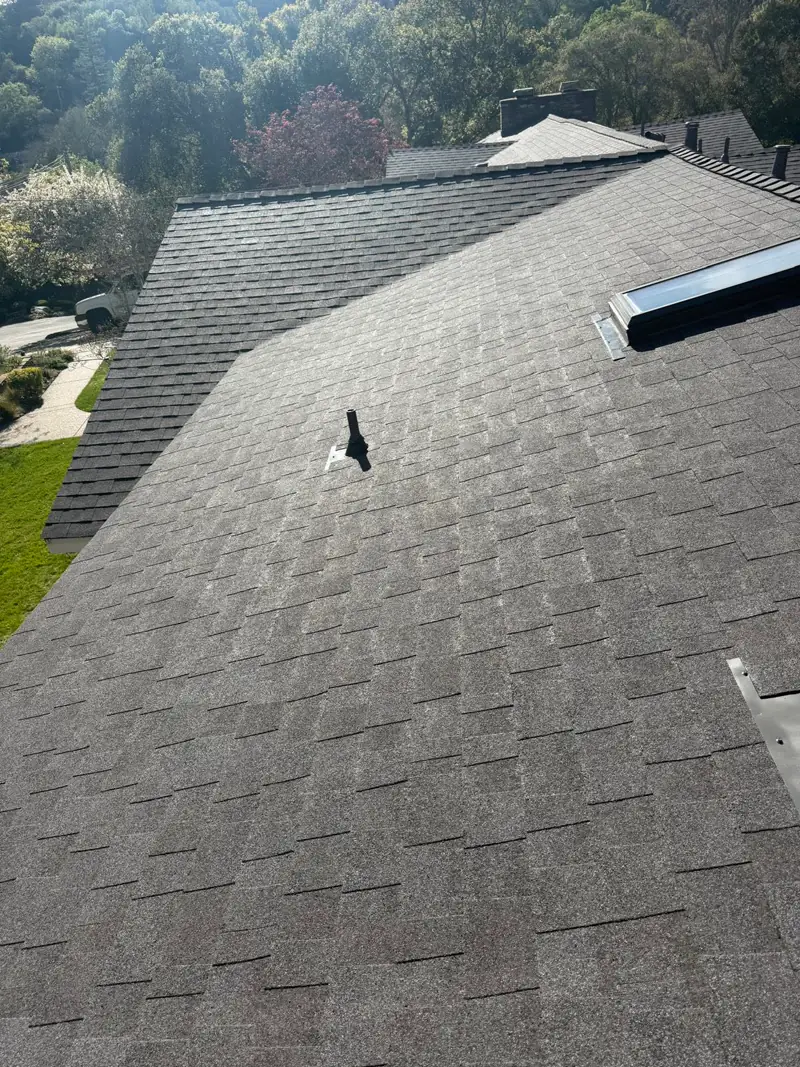
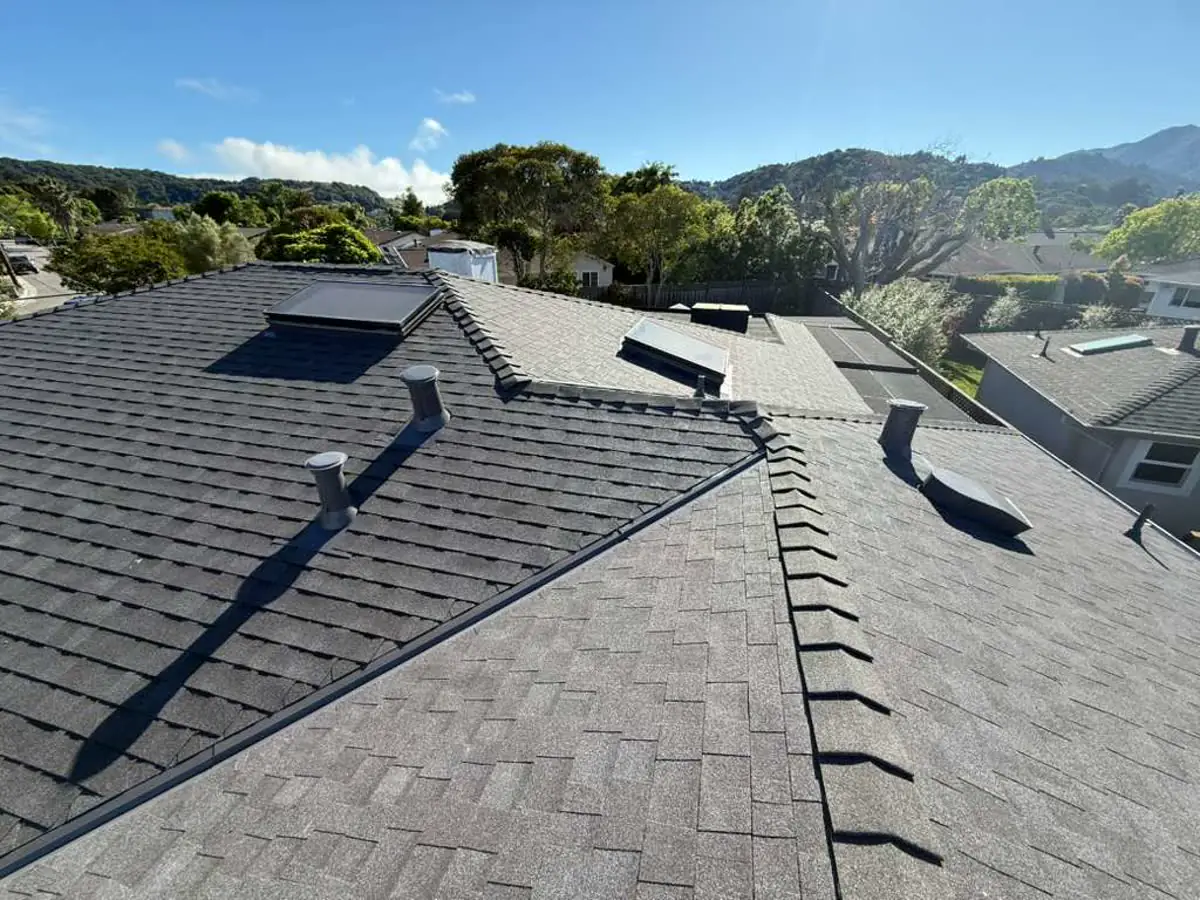
Year workmanship warranty spelled out in your contract, and added to the manufacturer's warranty on the materials.
We are the contractor of record on the permit, and every roof meets Florida code. You have no forms to fill out.
All the old roofing leaves in our trailer, and a magnet sweep of the yard and driveway picks up stray nails.
Florida certified roofing contractor CCC1336568, covered by general liability and workers' comp.
Spread the cost over monthly payments and replace the roof now instead of waiting until you've saved enough.
Belleair Bluffs Storm Damage Roof Repair Questions
How Many Belleair Bluffs Roofs Did Helene and Milton Damage?
No count has been published. We checked the city's website, news coverage and National Weather Service storm reports and found no tally of damaged roofs or homes for the city. The measured numbers come from the Clearwater Beach station about 4 miles north, so treat them as nearby readings, not the city's own.
I Own a Condo Unit and Water Is Coming Through My Ceiling. Can You Fix the Roof?
The building's roof belongs to the association, so the association decides who works on it. Tell your manager or board right away and share your photos. We can look at the roof once the association asks us to.
Will You File My Insurance Claim or Meet the Adjuster?
No. The claim stays between you and your insurer. What you get from us is a dated photo report and a plain opinion on repair or replacement, and you choose who sees it.
My Mail Says Belleair Bluffs 33770. Who Issues My Roof Permit?
It depends on the parcel. On pcpao.gov, a tax district of BBL means the city, where SAFEbuilt issues the permit. BTF means unincorporated land, where Pinellas County does. Some homes with the same mailing address sit in the City of Largo.
Nothing Looks Wrong from the Street. Could the Storm Still Have Hurt My Roof?
Yes. A gust can unstick a shingle and let it drop back flat, and dime-size hail can strip granules without leaving anything you would notice from the ground. Both usually show up as a leak in a later rain.
Can You Stop Water That Is Coming in Right Now?
Yes. When a leak is active, stopping it is the first thing we do on site. The full inspection and the photo report come after the water is under control.
Get Your Belleair Bluffs Roof Measured, Free.
Enter your address. We'll handle everything else.